George Papajohn | Beethoven Glosses 1
It is more or less the general opinion that the opening motto1 of Beethoven’s Fifth Symphony serves not just as a germ motive for the first movement, but occurs in some guise in the three subsequent movements as a unifying idea of sorts. This notion dates back at least to E.T.A. Hoffmann, and in spite of its detractors (e.g. Donald Tovey) it has had profound staying power. I don’t intend to contradict this prevailing assessment of the work, but rather to radicalize it a step further in order to demonstrate that the first notable integration of trombones into the classical symphony was not merely an orchestrational decision, but bears a deeply poetic relation to the motivic-thematic structure of the work.
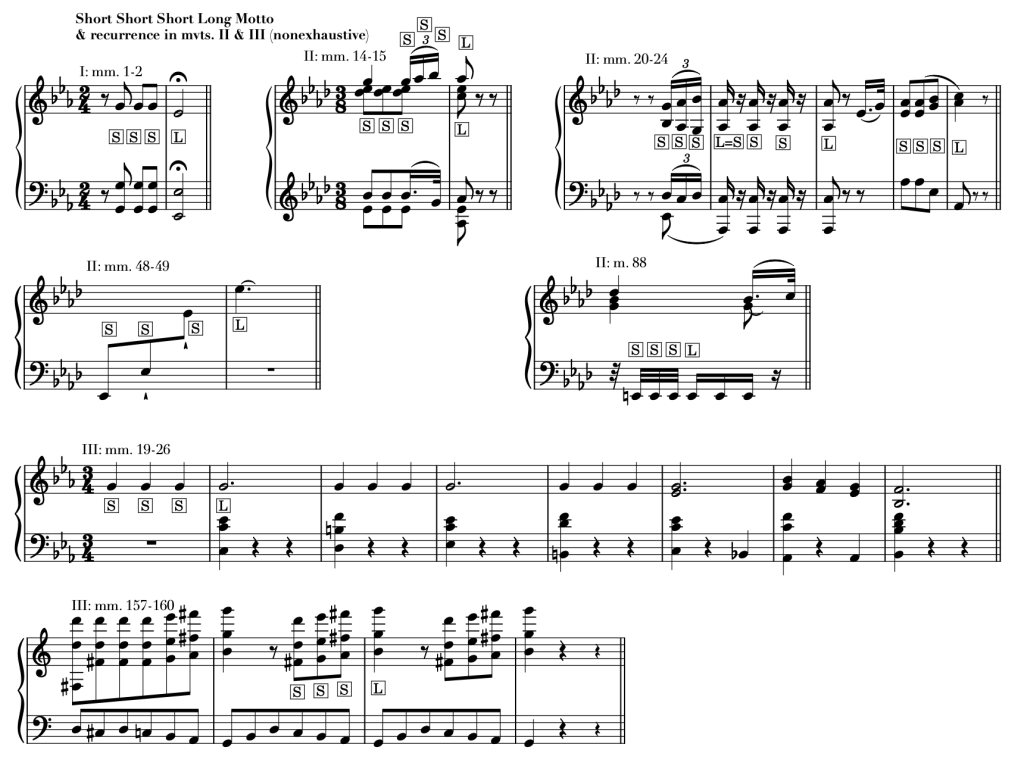
The first bars of the Fifth Symphony present an idea commonly described as a “short-short-short-long” rhythmic motive. The term “rhythmic motive” is correct in the sense that the motive is, for the most part, a meaningful figure as it pertains to the temporal aspects of the whole symphony—one which is much less relevant in terms of its pitch contour. But the term is misleading in the sense that, in the second and third movements, the particular rhythm of an off-beat three-note anacrusis leading to a (typically longer) strong beat is all but absent. Those three “shorts” lose their syncopated and anacrustic character more often than not. The glue that binds the motive together is not its literal rhythm, neither in the sense of proportions and ratios nor of accents and meters; rather it is bound together by that immediate descriptor “short-short-short-long.” When we identify the motive across the symphony, we do not look for the specific rhythm, but for the phenomenal experience of a motivic group with the temporal contour of “short-short-short-long.” When any motive is developed or transformed, some aspect of it must remain constant—otherwise every motive could be read as a variation of every other. What remains constant from Beethoven’s motto is not its particular rhythm, but its conceptual rhythm; whatever alterations are performed on the particular rhythm, it can always be described as short-short-short-long. This motive is raw and elemental—what unifies the concept of the motive is entirely prior to any musical system or syntax, yet inherent to human perception (auditory perception is largely governed by grouping principles reminiscent of Gestalt Psychology.)2 It is in this light—that there is no rhythmic motive but a conceptual motive—that I’d like to turn to the final movement of the Fifth Symphony.
While the primary theme contains some material with clear derivation from the unifying motive (most notably the sforzandi descending scale fragments and the rhythmic activation of the bass line near the end of the transition) the textbook example of the short-short-short-long motive in the final movement is the triplet figure of the secondary theme. This version of the motive seems to synthesize the anacrustic version of the motive from the first movement and the triple rhythms of the middle two movements. The consequent phrases of this secondary theme are accompanied by a generic 1-7-1-2 bass that appears so conventional in the exposition that one would scarcely take note of it on a first listening. The singular importance of this figure is only unfolded retroactively in the development.

The development begins with what appears a rote and generic imitative fantasy on the secondary theme, doubling down on the central importance of the short-short-short-long motive. But as this fantasy grows, the 1-7-1-2 countermelody becomes evermore insistent and present until the roles become strikingly reversed: the alto and tenor trombones enter together on the 1-7-1-2 figure, in a unison forte (doubled by fortissimo bassoons) against only the celli carrying the pallid secondary theme. The countermelody has here overtaken the theme and become the primary melodic idea for the remainder of the development.

Though remarkable in its own right, it is not just that this generic bass figure3 has mounted a coup against the symphonic material—wresting itself free from its subservient role—it is that the very essence of this figure is negation. The rhythmic contour of this new motive is always, without fail, short-long-long-long—the conceptual rhythm of the the main motive has been both reversed and inverted—doubly contradicted. This very figure, defined by negation, rises from the bass up to the violins and trumpets in ascending sequence. The symphony cannot withstand such an opposition without rupturing. The ten measures leading up to the retransitional dominant pedal are characterized by extreme fragmentation and intensification. The trombones’ “negative-motto” is cut short at its first two notes—radicalized to the pure diametric opposition of short and long in the strings. The winds struggle to maintain the initial motto as well, eventually stuttering anacrustic “short-short-short” figures with no “long” answer until they submit to the negative-motto, now in the tonic key over a dominant pedal. This formal gambit is so radical that the movement must literally stop and return to the music of the preceding scherzo in order to effect a retransition to its primary theme. It is only when one reads the rhythm of the motive conceptually—i.e. free from particulars of musical syntax—that this momentous transformation becomes legible.

This is why the Fifth Symphony introduces the trombone into the orchestra of the classical symphony. It is not a mere coloristic expansion. Indeed, the trombones are consistently integrated into a homogenous orchestral tutti from their first entrance at the top of the fourth movement. It would take an incredibly discerning ear to recognize that something was amiss with the orchestra during the exposition. It is not until they enter with the negative-motto in the development that the trombones become distinctly audible. And while the trombone notably affords the possibility of chromatic brass (the negative-motto enters in the key of the Neapolitan, which horns of the time could only perform on stopped notes) this alone does not account for Beethoven waiting until the middle of the development to let his trombones come to the fore. Mostly used in sacred music of the period, the trombone was historically a ritual instrument—as such it was associated with the transcendent beyond, and sometimes explicitly death, due to the use of the sackbut (the predecessor of the trombone) in funeral processions. The introduction of the trombone is not a neutral timbral decision but carries these connotations with it. In this context, the trombones in the Finale of Beethoven’s Fifth must be read as representing a symbolic death in the symphonic narrative, a passing of the musical subject into its other. One could invent no better material for this apotheosis than the conceptual negation of the symphony’s unifying motto.
- Granting that Dahlhaus and Schenker convincingly identify the first two unison iterations of the opening motive in tandem as the real “idea” of the first movement, by “motto” here I refer to the first four notes alone, this being the most consequential for the symphony as a whole; see: Dahlhaus, “Issues in Composition.” ↩︎
- See: Bregman, Auditory Scene Analysis. ↩︎
- It is perhaps relevant to note that the fugue subject in the Scherzo prominently begins with 1-7-1-2 (long-short-short-short !) and of course the secondary theme of the first movement contains the pattern in its legato 5-1-7-1-2-6-6-5, both possessing similar prosody [w-s-w-s] to the finale version; there are numerous less-obvious instances of this figure in the symphony, but they are likely non-motivic, as the figure is a standard bass motion in the style. ↩︎
 George Papajohn: Composer
Leave a comment